Selective Critique for Cost-Aware LLM Agents in Long-Horizon Decision Making
Abstract
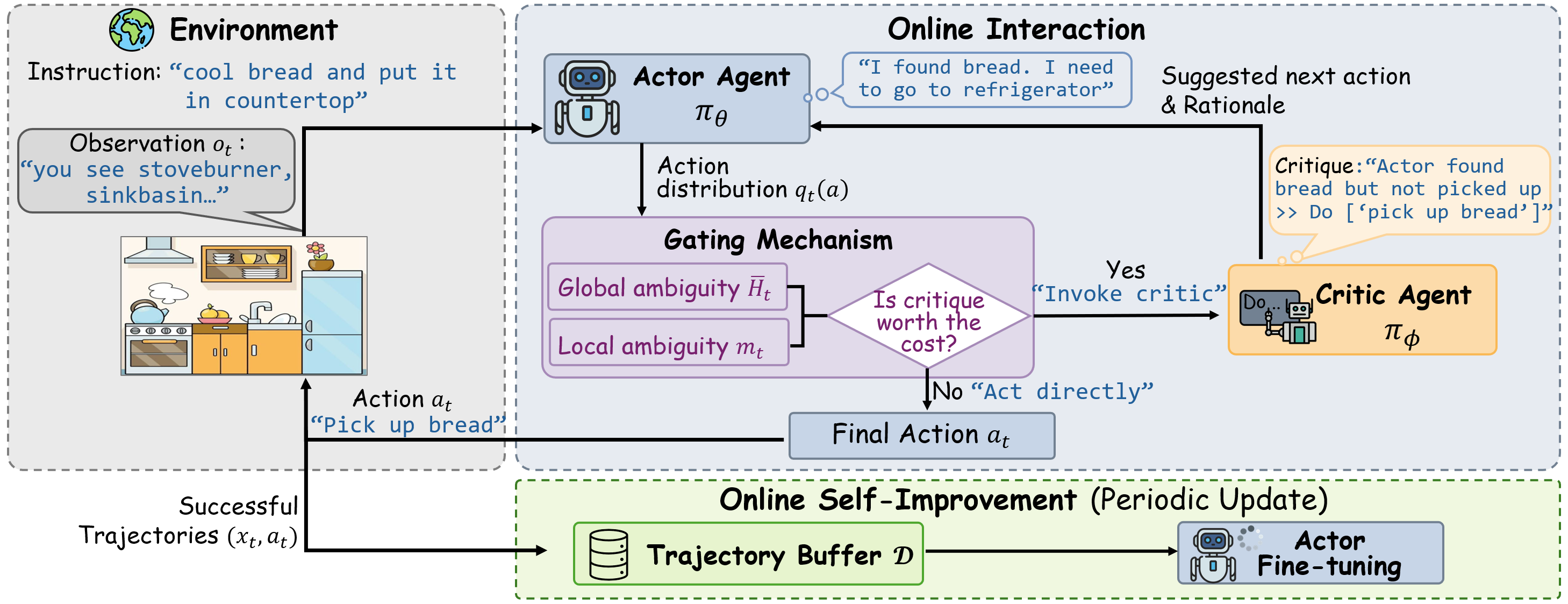
Improving the reliability of large language model (LLM) agents in long-horizon decision-making remains a key challenge. When deployed as autonomous agents interacting with complex environments, early mistakes can propagate through trajectories and cause cascading failures. Recent approaches improve reliability by incorporating external critique or deliberation, but invoking these mechanisms at every step substantially increases token consumption and latency, limiting practical deployment. We propose SAG (Self-improving Agent with Gated critique), a cost-aware framework that formulates critique invocation as a step-wise decision problem during long-horizon interaction. SAG introduces a lightweight, training-free gating mechanism that estimates the utility of critique using action-level ambiguity signals—global entropy and local top-2 margin—computed over admissible actions. From a decision-theoretic perspective, this mechanism approximates the Value of Information (VoI) of critique, enabling the agent to selectively allocate expensive feedback only when its expected benefit justifies the cost. SAG further incorporates online bootstrapped self-improvement, allowing the actor to internalize critic-assisted behaviors and progressively reduce reliance on critique. Across three long-horizon interactive benchmarks and multiple backbone models, SAG substantially improves the success–cost trade-off compared with both no-critique and always-on critique agents. On ALFWorld, SAG increases task success from 24.6% to 78.3% while maintaining a token budget comparable to ReAct, yielding a 3.1× improvement in normalized token efficiency. Moreover, a 7B actor with a lightweight 3B critic achieves performance comparable to a 14B actor without critique, showing that selective critique can recover most of the reliability benefits of deliberation while dramatically reducing inference cost.
Overview of Our Framework
Key Contributions
-
Strong Success–Cost Trade-off
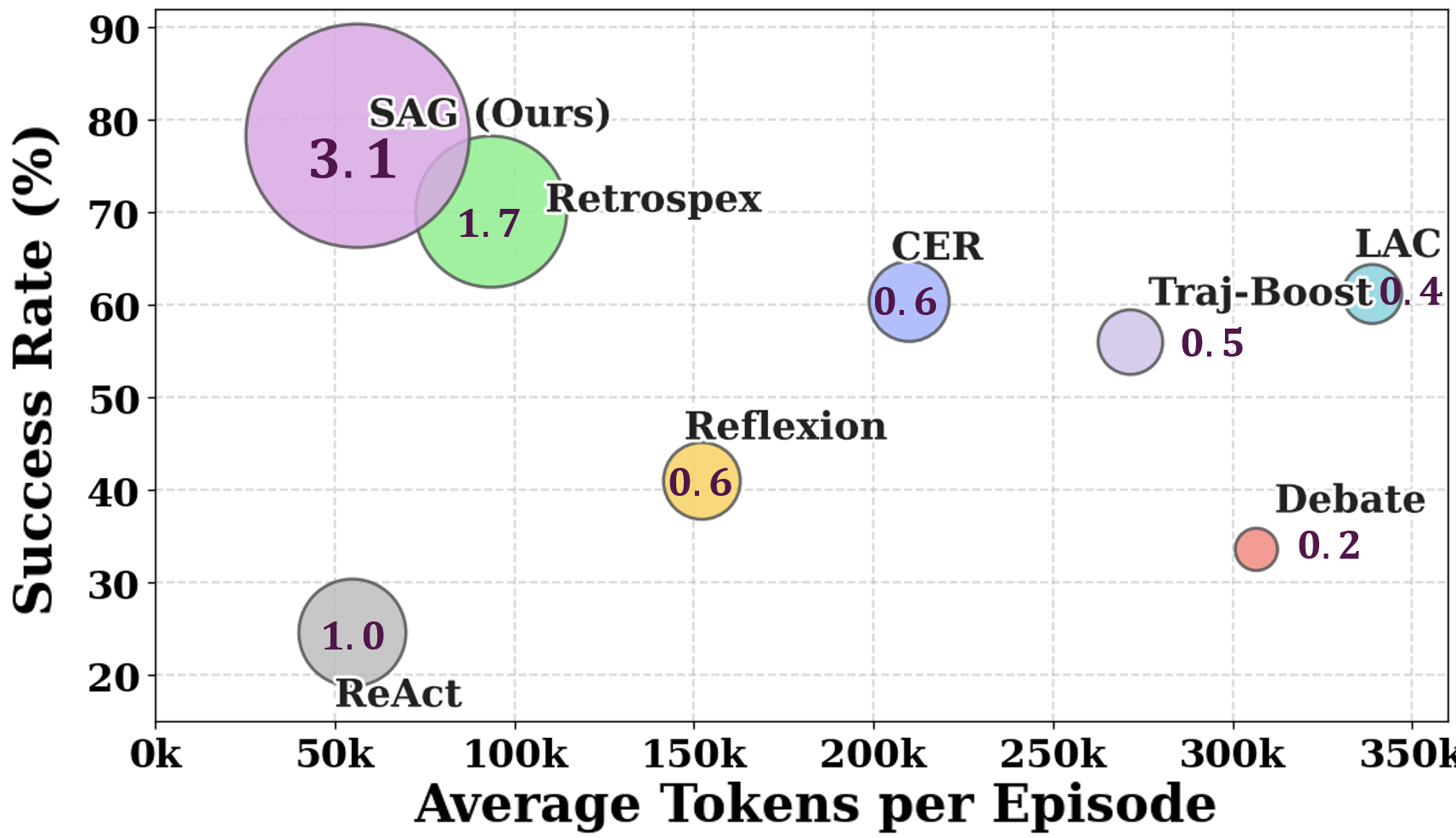
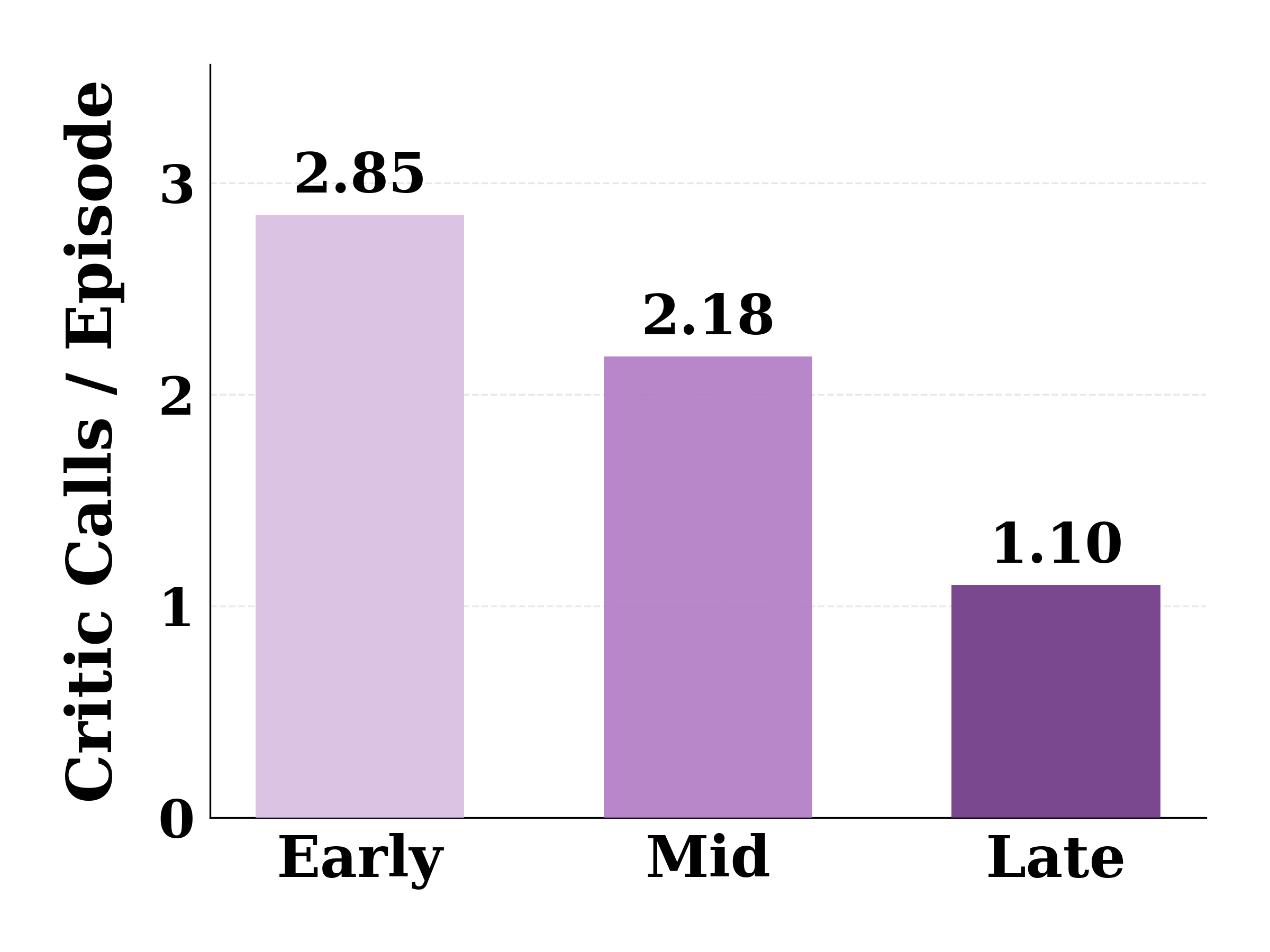
SAG achieves a strong success-cost trade-off, maintaining high success rates while using tokens efficiently. This enables performance comparable to always-on critique with a token budget close to no-critique agents.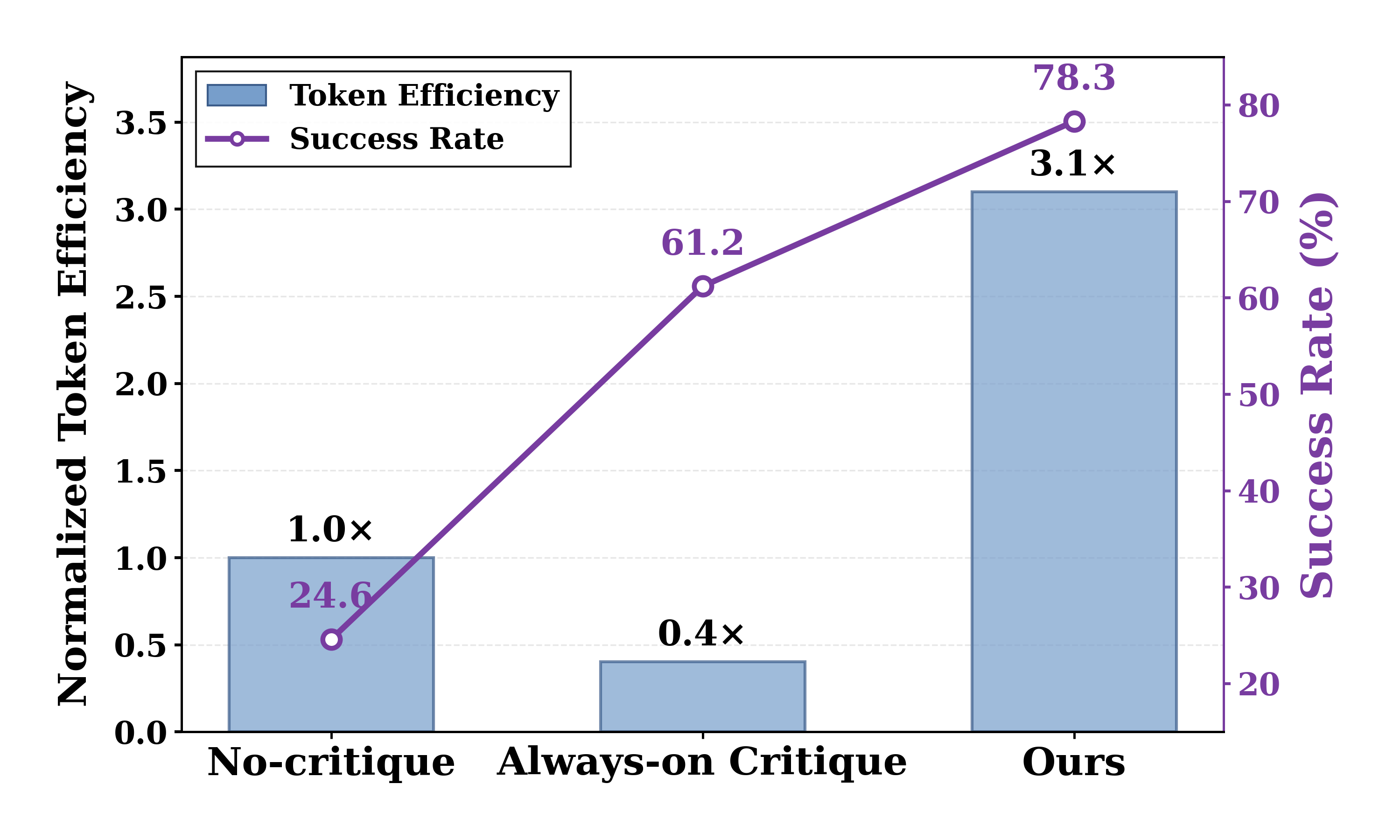
-
Lightweight Ambiguity via a VoI Perspective
SAG grounds critique decisions in a value-of-information framework using lightweight ambiguity signals derived from the actor’s action distribution. Global entropy and local top-2 margin provide a principled, low-cost gating rule without requiring additional models or supervision. -
Online Bootstrapping through Self-Improvement
Method
1. Decision-Theoretic Gating
SAG frames critique invocation as cost-sensitive decision-making. At each step, the agent evaluates whether the expected risk of error exceeds the cost of querying critique, and invokes the critic only when the decision rule favors intervention.
2. Robust Confidence Signals
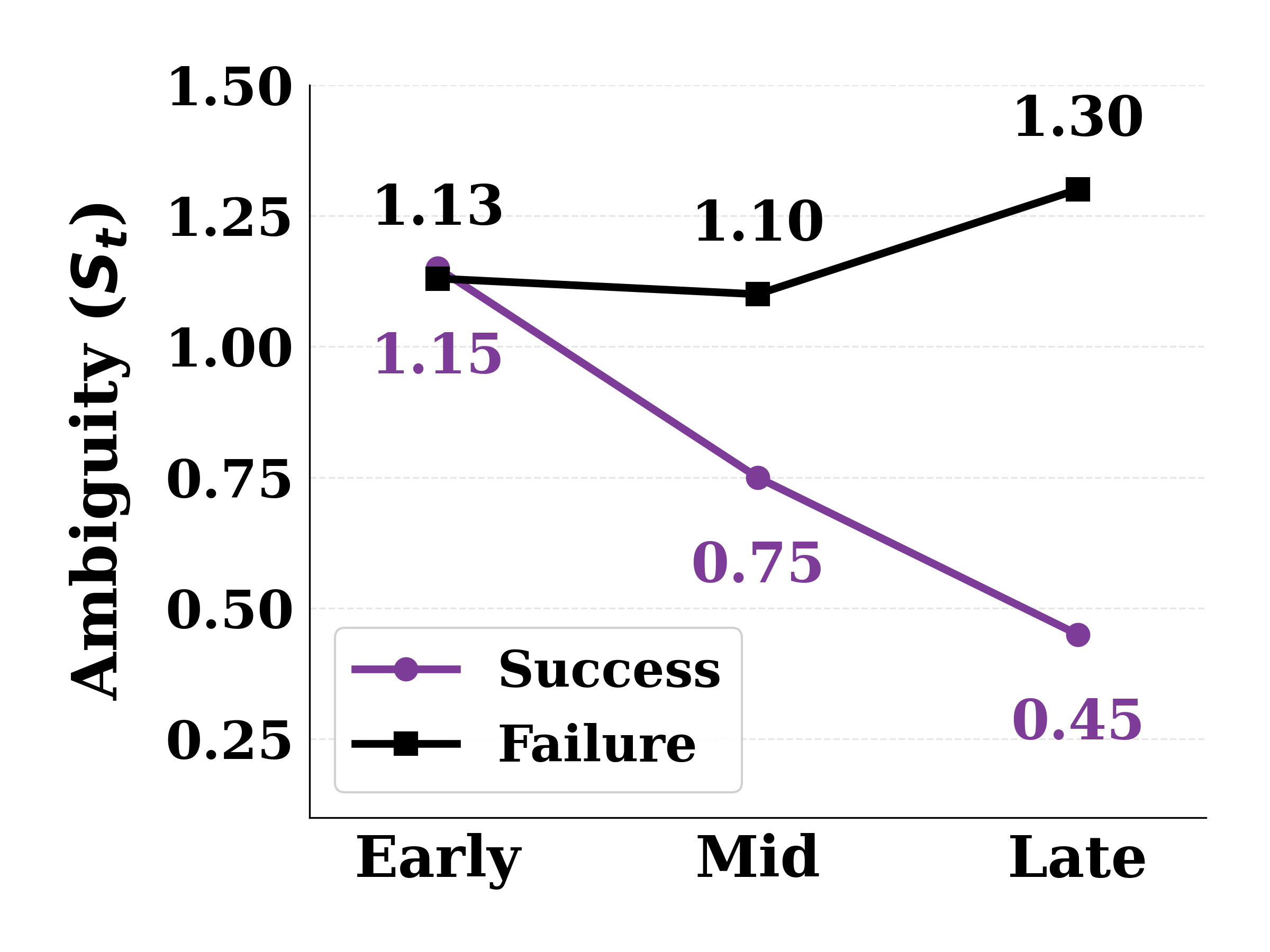
To support stable gating across dynamic action spaces, SAG derives uncertainty from the actor’s action distribution. Global ambiguity captures overall uncertainty (normalized entropy), while local ambiguity captures fine-grained confusion among top candidates (e.g., a small margin between the top-1 and top-2 actions).
3. Online Self-Evolution

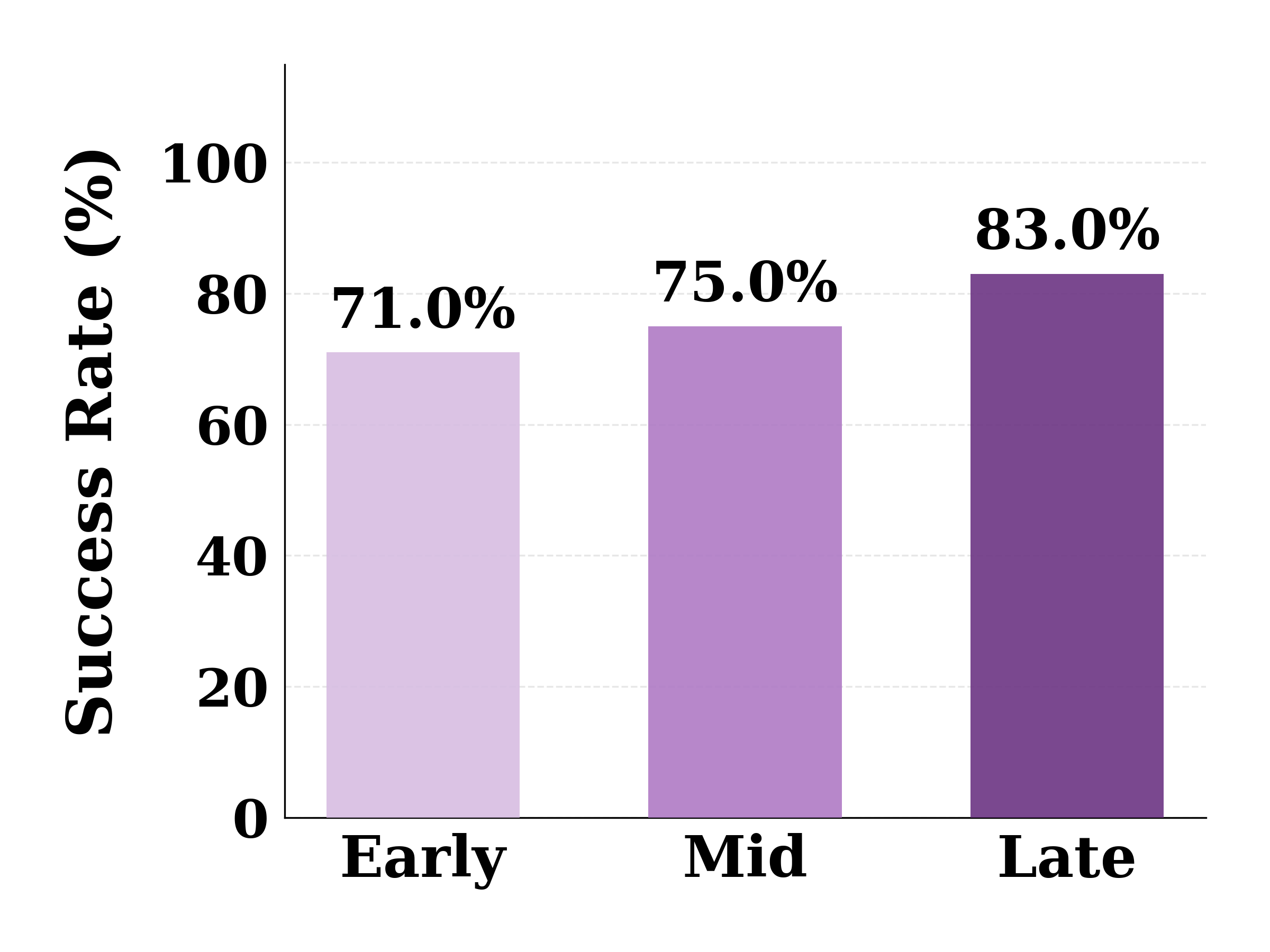
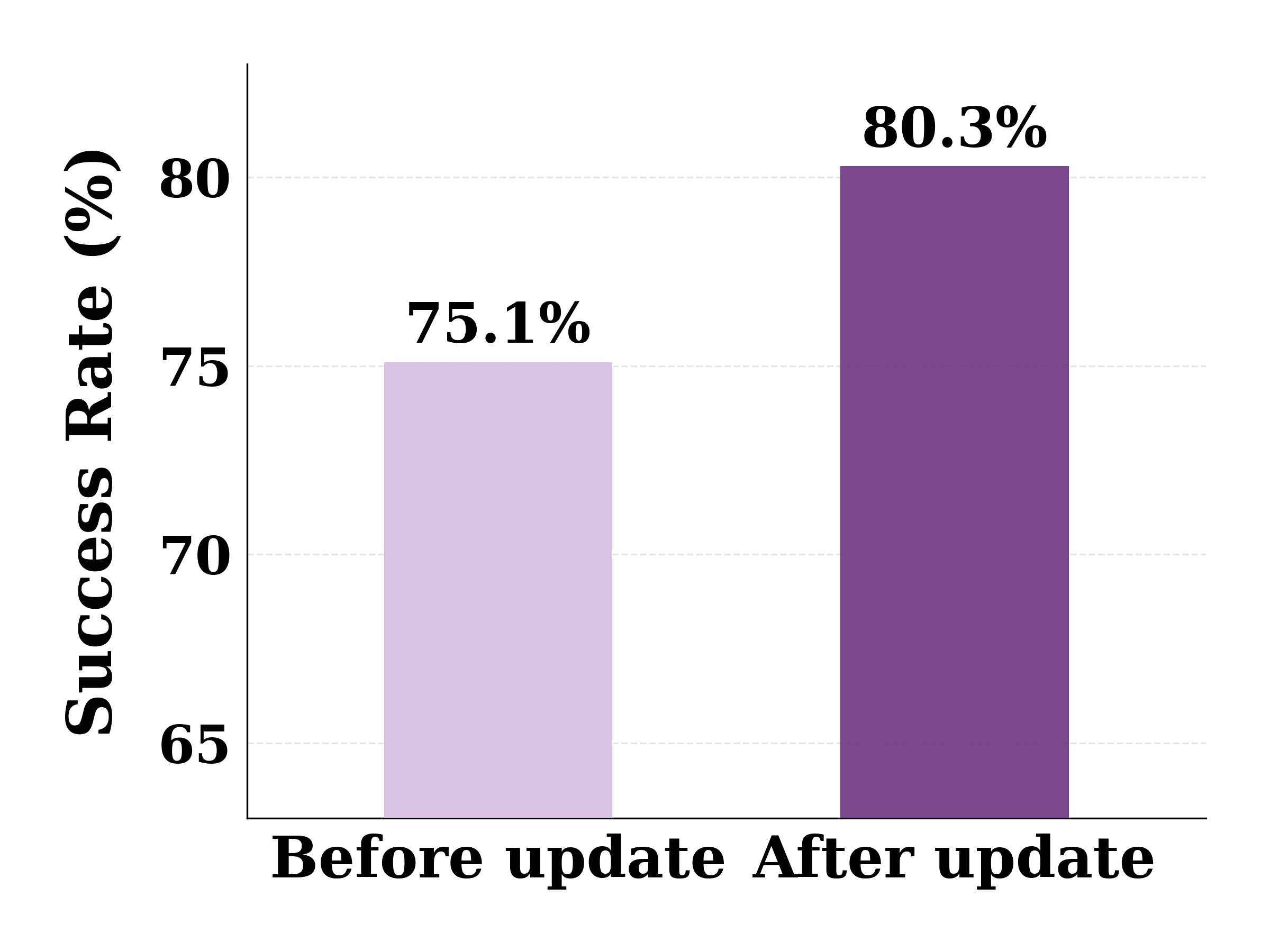
SAG stores successful trajectories (especially those improved by critique) and periodically fine-tunes the actor on these interactions. This enables the actor to internalize effective behaviors and gradually reduce dependence on critique during subsequent episodes.
Implementation Notes (Gate + Online SFT)
SAG uses a fixed gate threshold and a margin threshold for local ambiguity, and performs periodic online SFT using a buffer of successful interactions. (You can edit this block to match your final camera-ready hyperparameters.)
Demonstration Video
Results
Qwen2.5-7B-Instruct
| Method | Succ ↑ | #Horizon ↓ | #Token ↓ | Eff ↑ | Succ ↑ | #Horizon ↓ | #Token ↓ | Eff ↑ | Succ ↑ | #Horizon ↓ | #Token ↓ | Eff ↑ |
|---|---|---|---|---|---|---|---|---|---|---|---|---|
| ReAct (Basic) | 24.6 | 15.8 | 55 | 1.00 | 36.0 | 7.4 | 55 | 1.00 | 11.0 | 6.3 | 12 | 1.00 |
| Reflexion (Deliberation) | 40.3 | 16.3 | 150 | 0.60 | 41.0 | 7.0 | 162 | 0.39 | 11.5 | 6.8 | 15 | 0.81 |
| Debate (Deliberation) | 31.3 | 14.3 | 389 | 0.18 | 52.0 | 8.9 | 441 | 0.18 | 20.0 | 4.7 | 90 | 0.24 |
| CER (Deliberation) | 60.5 | 16.4 | 210 | 0.64 | 45.0 | 8.0 | 239 | 0.29 | 16.0 | 5.1 | 11 | 1.50 |
| Traj-Boost (Deliberation) | 56.0 | 12.9 | 272 | 0.46 | 44.0 | 10.0 | 85 | 0.80 | 24.5 | 5.1 | 12 | 2.19 |
| Retrospex (Critic) | 70.2 | 10.5 | 94 | 1.67 | 42.0 | 9.5 | 50 | 1.30 | 20.0 | 5.9 | 6 | 3.58 |
| LAC (Critic) | 61.2 | 14.2 | 339 | 0.40 | 47.0 | 10.5 | 436 | 0.17 | 25.0 | 6.5 | 82 | 0.32 |
| Ours (SAG) (Critic) | 78.3 | 11.4 | 56 | 3.10 | 70.0 | 8.1 | 78 | 1.38 | 37.0 | 5.8 | 9 | 4.55 |
Ablation Study (ALFWorld) - Click to open
Removing either global or local ambiguity degrades performance, while always-on critique incurs substantially higher token cost.
| Global | Local | Variant | Succ ↑ | #Horizon ↓ | #Token ↓ |
|---|---|---|---|---|---|
| ✓ | ✓ | Full (SAG) | 78.3 | 11.4 | 56 |
| ✗ | ✓ | w/o global ambiguity | 77.6 | 12.1 | 51 |
| ✓ | ✗ | w/o local ambiguity | 74.6 | 11.4 | 52 |
| ✗ | ✗ | Always (no gating) | 62.0 | 17.4 | 112 |
| ✗ | ✗ | w/o critic | 53.0 | 17.3 | 55 |
Case Study (ALFWorld) - Click to open
You are in the middle of a room. Looking quickly around you, you see
an armchair 1, a cabinet 4, a cabinet 3, a cabinet 2, a cabinet 1, a drawer 5,
a drawer 4, a drawer 3, a drawer 2, a drawer 1, a dresser 1, a garbagecan 1,
a safe 1, a shelf 12, a shelf 11, a shelf 10, a shelf 9, a shelf 8, a shelf 7, a shelf 6,
a shelf 5, a shelf 4, a shelf 3, a shelf 2, a shelf 1, a sidetable 1, and a sofa 1.
Your task is to: put two pillow in sofa.

> [Agent] Act 1: think: To solve the task, I need to find and take the first pillow, then put it in sofa, then find and take the second pillow, then put it in sofa.

OK.

> [Agent] Act 2: think: First I need to find the first pillow. A pillow is more likely to appear in armchair (1), cabinet (1-4), drawer (1-5), dresser (1), sidetable (1), sofa (1). I can check one by one, starting with armchair 1.

OK.

> [Agent] Act 3: go to armchair 1

You arrive at armchair 1. On the armchair 1, you see a cellphone 2, a pillow 2, and a pillow 1.

> [Agent] Act 4: take pillow 1 from armchair 1

You pick up the pillow 1 from the armchair 1.

> [Agent] Act 5: think: Now I find the first pillow (1). Next, I need to put it in sofa 1.

OK.

> [Agent] Act 6: go to sofa 1

You arrive at sofa 1. On the sofa 1, you see a newspaper 3.
> [Gate] global ambiguity H̄t = 0.20, local margin mt = 0.06 < δ
> [Gate] score St = H̄t + I[mt < δ] = 1.20 > τ  (VoI proxy > cost) ⇒ critic invoked

> [Critic] Suggested action: move pillow 1 to sofa 1
> [Critic] Rationale: You are close, but you forgot to put the first pillow in the sofa before searching for the second one. Putting the first pillow in the sofa now reduces the risk of forgetting it later.
> [Agent] Act 7: move pillow 1 to sofa 1

On the sofa 1, you see a newspaper 3, and a pillow 1.

> [Agent] Act 8: go to armchair 1

You arrive at armchair 1. On the armchair 1, you see a cellphone 2, and a pillow 2.

> [Agent] Act 9: take pillow 2 from armchair 1

You pick up the pillow 2 from the armchair 1.

> [Agent] Act 10: think: Now I find the second pillow (2). Next, I need to put it in sofa 1.

OK.

> [Agent] Act 11: go to sofa 1

You arrive at sofa 1. On the sofa 1, you see a newspaper 3, and a pillow 1.

> [Agent] Act 12: move pillow 2 to sofa 1

You move the pillow 2 to the sofa 1.

Outcome: success
> [SAG] Successful episode. Trajectory is added to the self-improvement buffer.